
Within the “Pan-Euro-Mediterranean” (PEM, for short) free trade area, the modernisation and harmonisation of the rules of origin has made significant progress. However, for a one-year transitional period, a complex legal situation still exists within this preferential area:
In 2025, two preferential agreements apply in parallel:
- the existing “old” PEM Convention (Regional Convention, RC) of 2012 (OJ EU L 54/4 of 26 February 2013), and
- the new, “revised” Regional Convention (the “revised rules”), adopted in 2023 (Decision No. 1/2023, OJ EU L of 19 February 2024).
From 2026 onwards, as things currently stand, only the more modern revised RC is to apply.
Already over the past three years, companies were confronted with the situation that, within the PEM area, two systems applied in parallel between individual contracting states: the existing “old” RC and the so-called “transitional rules.” During the 2025 transitional phase, it is possible that, depending on the contracting partner, instead of the two systems applying in parallel, only the “old” RC, or only the new, revised Convention, applies. This mixture of three possible scenarios stems from the following:
For the revised Regional Convention to apply, the bilateral protocols between the contracting states must contain a reference to the new Convention. By means of a dynamic reference, the reference points to the legislation “as most recently amended,” so that the current version always applies. Several contracting parties were, owing to their internal procedures, unable to insert such a dynamic reference into their bilateral protocols in time for 1 January 2025. This means that the new, revised Convention does not apply in relation to those states.
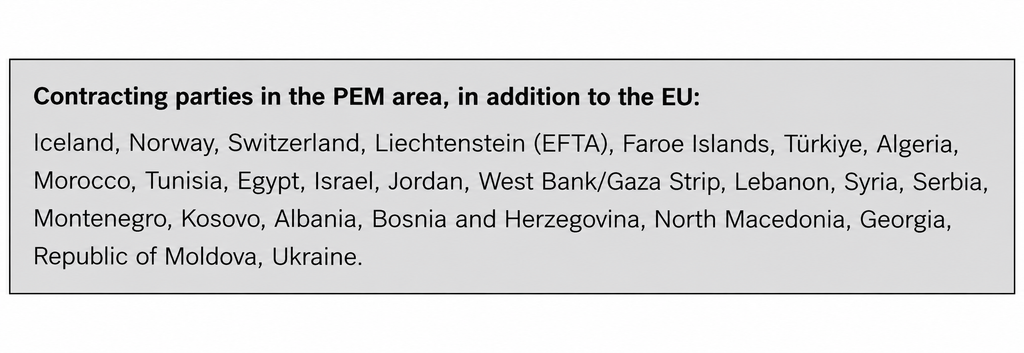
At this point, it should be noted that the PEM area is a large free trade zone, comprising, alongside the EU, 24 further contracting states. This, on the one hand, is what makes free trade within this preferential zone so attractive, but, on the other hand, also means that the entry into force of a uniform agreement proceeds slowly, since a correspondingly large number of individual ratification processes must be coordinated with one another.
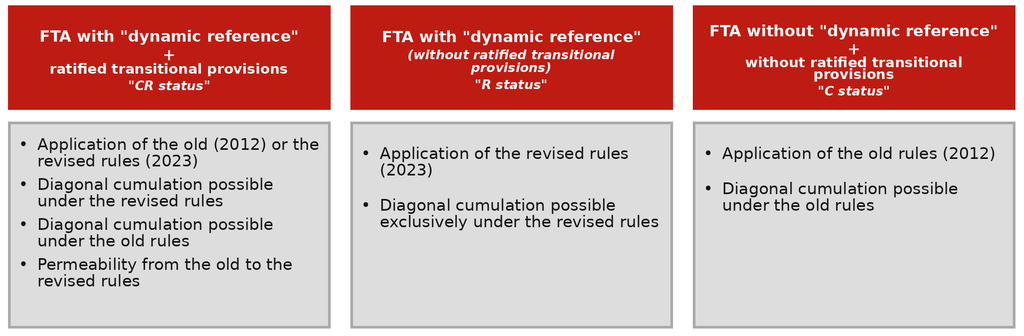
This already complex starting position is further compounded by the fact that the contracting parties have agreed transitional provisions to determine the preferential treatment to be granted to goods exported from one contracting party before the revised rules entered into force, but imported into another contracting party after those rules entered into force. Put simply, this concerns how the application of old and new law is to be structured during the transitional period. These transitional provisions were added to the revised Convention. Accordingly, where the bilateral protocols between the contracting parties contain a dynamic reference to the revised Convention, the modernised rules apply, and, automatically, so do the added transitional provisions. Where the protocols do not (yet) contain such a reference, the existing “old” rules of the RC (2012) continue to apply. In some cases, the protocols do contain a reference to the revised Convention, but the transitional provisions have not been ratified and added, meaning that, between those contracting states, only the revised Convention applies.
In summary, then, there are the following three case groups:
The EU Commission has published a so-called MATRIX (OJ EU C of 22 January 2025), which shows which status applies to each of the EU’s contracting partners:
- Parallel application of both sets of rules: marked CR (e.g., EU–Switzerland)
- Application of the old RC (2012) only: marked C (e.g., EU–Morocco)
- Application of the revised Convention (2023) only: marked R (e.g., EU–Albania)
Since individual contracting states will complete their ratification processes over the course of the year, ongoing changes to these “status relationships” are possible. The EU Commission has announced that it will regularly publish an updated overview matrix. Even before such a publication, information on current developments is intended to be available on the Commission’s website.
What applies to proofs of preferential origin and supplier’s declarations?
deutThe decisive question for importers and exporters is which proofs of origin apply and will be recognised by customs. This is governed by the transitional provisions referred to above, published by Decision No. 2/2024 in OJ EU L of 9 January 2025 (2025/17):
- All proofs of origin issued before 1 January 2025 under the “old” PEM Convention will, after 1 January 2025, continue to be recognised, within their period of validity, for products that, as at 1 January 2025, were either under a transit procedure or had been placed under a special procedure under customs supervision (Article 42(4)).
- The same applies to proofs of origin issued before 1 January 2025 under the previous transitional rules, Article 42(2). The German customs administration notes, on its information page, that proofs of origin mistakenly still issued in 2025 bearing the annotation “transitional rules” instead of “revised rules” should likewise not be rejected.
Until 31 December 2025, for trade in goods with countries applying the transitional rules, and therefore both systems in parallel (CR status), movement certificates EUR.1 issued under the revised Convention must bear, in Box 7, the annotation “REVISED RULES” in English. This annotation must also be added at the end of the statement on origin. It is important that this addition is observed, since it does not follow from the wording of the statement on origin set out in the WuP database (wup.zoll.de), but is instead found, somewhat tucked away, in the transitional provisions, Article 42(9). It should also be noted, however, that this addition is only required where the origin of the goods was determined on the basis of the revised Convention. The correct document coding for the recognition of proofs of origin on import can be found in ATLAS Info 0695/24.
As regards supplier’s declarations, there are as yet no clear statutory rules; the EU Commission has announced that it will amend the rules on supplier’s declarations in the UCC Implementing Regulation (Article 61 et seq.). The German customs administration recommends adding the annotation “REVISED RULES” to supplier’s declarations for goods that have acquired origin under the revised RC. For supplier’s declarations issued in 2025 that bear no such annotation, it is to be assumed that origin was acquired under the rules of the previous RC (see the customs administration’s specialist article of 23 December 2024).
What applies to cumulation?
The contracting parties have agreed that, wherever possible, cumulation between the different sets of rules should be permitted during the period of parallel application. This means that:
- proofs of origin issued under the previous transitional rules can also be used for cumulation purposes under the revised Convention (Article 42(2));
- cumulation is possible where a supplier holds proofs of origin issued under the old rules that provide for diagonal cumulation, but the exporter wishes to apply the revised rules. This permeability is allowed because the old rules generally provide for stricter rules of origin than the revised rules. For certain goods, in particular in the agricultural sector, this permeability does not apply (see Article 8(1a) of the revised Convention).
- there is no permeability in the reverse direction, meaning that, within the “old” system, products that acquired origin under the revised agreement cannot be used for cumulation purposes.
Outside of parallel application, that is, where contracting partners apply either only the “old” RC (C status) or only the revised RC (R status), diagonal cumulation with a third partner can only take place if all three partners share the same status, either all C or all R (see the MATRIX of 22 January 2025 on this).
What advantages does the revised Convention offer?
The aim of revising the PEM agreement was to establish more modern and flexible rules of origin. Simpler list rules have been created. For example, the distinction between columns 3 and 4 of the processing rule has been dropped, and more generous value clauses now apply. The ex-works price, as well as the value of non-originating materials, can now be calculated on the basis of average values for a tax year. In addition, a higher value tolerance for non-originating materials has been agreed, which can likewise make it easier for products to acquire origin than before, particularly since origin can more frequently be acquired through a change of tariff heading.
Overall, then, it may well be worthwhile for companies to familiarise themselves with the new, revised rules of origin. In particular, in cases where the acquisition of origin has previously failed on account of the 40% value clause, it is worth checking which processing rule applies under the new rules, since this may turn out to be more favourable. The permeability rules agreed in the transitional provisions make handling the parallel systems considerably easier than was the case during the period in which the “old” RC’s rules of origin and the so-called TRANSITIONAL RULES existed in parallel, where strict separation was required.
It is also worth noting that the revised Convention now provides for only a single form of movement certificate or statement on origin, namely the EUR.1 declaration. The EUR-MED movement certificate and EUR-MED statement on origin, with their rather complicated requirements, have been abolished. Where products have acquired origin status through the application of cumulation of origin, the proof of originating status should, under Article 8(3), contain the following statement in English: “CUMULATION APPLIED WITH (name of the relevant applying Contracting Party/Parties in English).” Where a EUR.1 movement certificate is still used as the proof of origin, this statement must be entered, in English, in Box 7 of the form.
As regards the confirmation of origin, all signs point towards a shift to digital processes: going forward, contracting parties are to be able, under the revised Convention, to establish a system enabling proofs of origin to be issued and/or transmitted electronically (Article 17(4)). Until such a system has been established, contracting parties should, under certain conditions (points (a) to (d)), accept electronically issued movement certificates presented on import (amendment pursuant to Decision No. 1/2024, OJ EU L of 9 January 2025).
We are very curious to see whether the new rules will already gain traction during the 2025 transitional phase. If you have any questions, please feel free to get in touch!
